|
Safe
in Unsafe Places: Leisure, Passionate Avocations, and the Problematizing
of Everyday Public Life
Dair
L. Gillespie
University of Utah
Ann Leffler
1
Utah State University
Elinor
Lerner
Stockton State College
Leisure is often
distinguished from and considered subsidiary to some other
world, the "real" world. This paper explores how participation
in passionate avocations - leisure pursuits both generating
and requiring heavy personal identity investments - affects
the public interface between the "real" world and the alternate
world of the passionate avocation. We use the world of dog
sport enthusiasts to problematize polar conceptualizations
of certain important aspects of social life. In particular,
we examine shifting experiential definitions of "safe" and
"unsafe" public places by looking at how participation in
dog sports shapes both the possibility of certain kinds of
public interactions and also participants' public identities
- how they define themselves and are defined in public. The
data come from four major sources. First, since 1992 we have
interviewed approximately 50 enthusiasts in various dog sports.
Second, by training and showing our own dogs, we enjoy participant
observer access to a variety of dog-related activities and
people. Third, we are involved in several Internet groups
about dogs. Finally, using a technique Denzin (1989) terms
"auto-ethnography," two of the authors toured the country
for nine months, attending dog sports events and training
sessions and conducting interviews.
When
Worlds Collide: Hobbyist Identities in Public Space
Our new
hobbyist identities changed our patterns of interaction with
the real world. The frequency and kinds of interactions we had
in public places shifted, as did the way we "felt" about those
interactions, the social categories of persons with whom we
interacted, how we (and others) defined the situation, and who
became socially defined as "folk" versus stranger, friend vs.
problematic encounter. We do not know, of course, the degree
to which the specifics of the shifts depended on the fact that
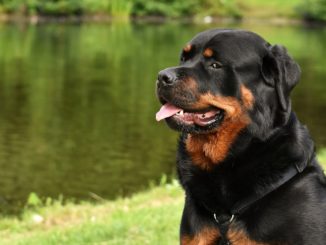
our hobby objects were dogs in general or Rottweilers specifically.
In this paper, we will simply report the shifts, hoping that
future research can clarify which kinds of hobbies and hobby
objects make which kinds of differences.
The
changes in public identity we experienced are not predicted
in the literature. Various studies report that being accompanied
by a dog in public places facilitates social contact and lubricates
social interaction (Gardner, 1980; Messent, 1983, 1985; Dunbar,
1987; Hart, Hart & Bergen, 1987; Eddy, Hart & Boltz,
1988; Manor, McCurdy & Crain, 1988; Mader, Hart & Berger,
1989; Robins, Sanders & Cahill, 1991; Rossbach & Wilson,
1991; Edney, 1992). Some studies even recommend providing dogs
for social isolates (Corson & O'Leary, 1981; McCullouch,
1983; Silverman, 1985). While we had many encounters supporting
these findings about the positive effects of being accompanied
by a dog, our overall experience suggests a much more complex
effect. Sometimes being accompanied by dogs facilitated social
contact between us and the people we met in public places. Sometimes
it did the reverse.
Dogs
as Impediments to Social Interaction: Safe in Unsafe Places
Being
accompanied by hobby dogs necessarily exposes travelling enthusiasts
to potentially unsafe situations, environments and times. Being
out at night, around strangers, and in "bad" neighborhoods or
isolated places is anxiety provoking for many people. It is
particularly problematic to women unaccompanied by a man, for
underlying any woman's encounter with strange men in unfamiliar
places at dangerous times is always the possibility of sexual
violence (Bart & Moran, 1993). This possibility is unavoidable
for dog hobbyists, most of whom are women, because dog hobbies
involve travel to unfamiliar places, because of the need to
find a motel that accepts dogs, and because the dogs must be
"run." An example from the field notes:
It
is a stormy winter night. I am running the two dogs alone
on an isolated beach at the New Jersey shore. The moonlight
shines over my shoulder, casting a long shadow on the sand.
The dogs' black coats make them invisible in the gloom. This
would be a great place to make a stalker movie; it looks menacing
in the dark with the moon, sand, and fog. Large shadows suddenly
join mine. Two white men are hulking above me on the dunes
which separate us from sight of the town. "Hi," I say, thinking
they too probably are running dogs. They make no response,
only keep moving toward me. Danger alert! I turn the dogs
so the men can see them, and detach their leashes. As I hoped,
the dogs pull forward. Holding onto their collars, I try to
look as though barely containing them from attack. This works.
The men flee, one muttering, "Just keep those dogs away from
me," the other prayerfully chanting, "Nice dog, nice dog."
(AL, field notes, 3/3/94)
The important
point here is that in the end the men did make conciliatory
noises and they did move away. They had lost their sense of
public safety, while for the author the definition of the situation
had reverted to "safe" place, time, interaction. As participants
and potential victims in ambiguous situations like these, women
never know if such encounters are truly threatening, or if the
men are getting pleasure from menace but will not actually attack,
or if they are innocently friendly. This ambiguity, the fact
that women cannot afford to be unsuspicious in encounters with
strangers at "dangerous" places and times, makes the issue of
defining "safe in public" a continual concern. Depending on
the political climate, the same is true for other at-risk groups,
for instance black people in white territory (Griffin, 1977).
A number
of similar experiences occurred throughout our months of travel
with the dogs, ranging from silent hulking night encounters
like the one described above to an assault on the trailer one
night in an isolated California campground by a carload of white
men. In each case the presence of the dogs changed the definition
of the situation for us from "unsafe" to "safe" and for them
from "safe" to "unsafe." No doubt one influence on the situation
was a current social definition of the dogs' breed. Rottweilers
are often typecast in popular media and in apocryphal urban
legends as the canine villains of the day, like Doberman Pinchers,
St. Bernards (Hobbs, 1995), and German Shepherd dogs before
them. The joy of being accompanied in such situations by dogs,
at least by dogs stereotyped as dangerous, is that, by virtue
of the dogs' presence, the potential victims have the power
to turn the tables on the potential attackers. Now they cannot
know if the dogs are truly dangerous or if the potential victims
are just getting pleasure by redefining the place, situation,
and time as "unsafe" for the potential attackers. Such is the
thrill of canine counter- terrorism.
Being
a hobbyist in public, then, or at least a hobbyist with one's
hobby objects visible and socially defined as threatening, far
from facilitating social interactions, sometimes actively discourages
them. Often this made us feel safer, while diminishing others'
peace of mind. Across ethnicities, races, genders, and ages,
some people would cross the street to avoid us when we were
accompanied by the dogs, especially at night. Some people also
avoided the parked van when the dogs were in it. Their discomfort
made getting in the car, driving at night, or breaking down
on the road much less worrisome for us than otherwise would
have been the case. In isolated campgrounds, park rangers and
fellow campers told us that just seeing evidence of big dogs,
e.g., large exercise pens, crates, and Rottweiler license plate
brackets on the van, often discouraged people from coming into
our campsite even when we were not there.
As
a result of these experiences, we became much more at ease moving
around at night and in situations and locations which we would
have assiduously avoided without the dogs. "Unsafe" situations,
times and locations became almost "safe." Walking at night with
the dogs in urban areas, in isolated campgrounds, on strange
country roads eventually became experiences to look forward
to. They had become socially redefined (for us) as "safe." In
A New Leash on Death, novelist Susan Conant says, "Want to take
back the night? Get a [big] dog..." (1990, p. 130). We expressed
this sentiment as, "Thank God we had our Rottweilers with us
when we had to run our Rottweilers at 2:00 a.m."
Dogs
as Impediments to Social Interaction: Unsafe in Safe Places
However,
being accompanied by the dogs, while increasing our sense of
safety in unsafe places, times and situations, also diminished
our comfort in what as real world denizens we had once considered
safe places, times, and situations. Fear of the dogs caused
some people to act in ways which indeed made danger more likely
- for the dogs. Again, the social definition of these hobby
objects may have been an issue. The stereotype of Rottweilers
as large and vicious meant that normal canine behavior they
exhibited, e.g., sniffing pants legs or woofing at strangers,
might be considered aggressive. In other words, sometimes the
visible presence of our hobby objects, the dogs, made some people
feel unsafe, in the process creating problems of control and
definition of the situation for us. And dogs perceived as a
breed "dangerous to the public" are at risk of being shot, poisoned,
hung, or stomped to death by individual vigilantes or executed
by the state for exhibiting ordinary canine behavior. For example,
in a recently reported instance, Animal Control at Stewart Air
Force Base put down two Rottweilers who had escaped from a fenced
yard. Although the dogs' neighbors, veterinarian, and the base
police wrote letters that the dogs were friendly, Animal Control
declared them "dangerous" and killed them because they had been
hard to capture (Gardner, 1995).
We could
not always prevent the possibility of negative public encounters.
So we faced a definitional problem of how to recontrive them
as non-threatening, even friendly and pleasant - safe for the
people our dogs might frighten. This was especially difficult
because one of the dogs was an exuberant youngster who adored
people and other dogs. A 50 lb. Rottweiler puppy lunging and
slobbering at the end of her leash to reach you, however, is
not necessarily a soothing sight for "non-Rott" people. Hauling
back on the leash and shouting the classic obedience commands
of "Leave it" or "Out" do not necessarily reduce targets' anxiety
either. After some experimentation, we finally hit upon the
perfect control command: "No kissing!" Termed an "excusing tactic"
by Sanders (1990) - a technique by which behavior is recast
as positive rather than negative - it worked like a charm; it
redefined the puppy's behavior as positive and the situation
as safe. It often brought a smile to previously frightened faces.
"Excusing
tactics" and the need for them are periodically discussed
on a Rottweiler Internet group. One participant, "JC," reports
that putting a backpack on a bitch before public appearances
"made a noticeable difference in the way [she]...was looked
at" (Rottie-L, 8/7/95).
A common
way in which we posed threats to others as hobbyists on public
ground was that the presence of the dogs sometimes inadvertently
activated our privileged white racial status. Anderson reports,
"As a general rule, when blacks encounter whites with dogs in
tow, they tense up and give them a wide berth, watching them
closely" (1990, p. 222). Across genders, ages, and classes,
some black people were very wary of our dogs, particularly in
the South (Brown, 1985). Clearly canine counter-terrorism, vengefully
amusing on a nighttime beach in New Jersey, could make us the
equivalents of those silent hulking sexual terrorists ourselves
- white people with "attack dogs." For instance, in motels with
large middle-class black clienteles, on our way to or from our
rooms with the dogs we often encountered black guests. Some
would quickly back up into their rooms again, or ask if the
dogs were attack dogs, or say, "Now don't let that dog bite
me." While some whites also showed fear, our dogs were more
likely to distress black guests in this situation. Another example
of a hobby activity making race salient occurred while driving
through North Carolina:
We stopped
to walk the dogs in a country hamlet. An empty lot by the railroad
tracks behind a Dairy Queen seemed ideal. But as we walked the
dogs we realized that the path through the lot was a short-cut
heavily travelled by black people. While we were there, some
women and men made a big loop to avoid us; some monitored us
out of the corners of their eyes, but stayed on the path; and
a couple of men stood off at the edge of the field and just
watched us the whole time. Others joined them until a small
clump of men had gathered to observe. Knowing how it felt to
be silently stalked and trying to change the definition of the
situation to at least a neutral one, we greeted every person
who approached with a big friendly smile - which, given the
South's race/gender history, was not necessarily helpful, but
we had no idea of what else to do. To rush away might have echoed
yet another bitter race/gender reality, that for black people/men
to congregate in public space causes white/female flight. During
the entire series of encounters (with about 10 people, men and
women, over approximately a 10 minute period), nothing was said
by anyone but us. We left as soon as we could. (DLG, field notes,
3/18/94)
Besides
being concerned that some people would define a situation involving
Rottweilers as unsafe for themselves, we also had to worry that
fearful people would innocently or ignorantly provoke the dogs
into appearing vicious. What was at stake for us in such instances
was more than simply public etiquette. At least according to
Rottweiler folklore, dogs are sometimes shot out of such groundless
fears. For example, even though our dogs are extremely dog friendly,
people with smaller dogs sometimes interpreted the Rotts' very
presence as dangerous to their dogs. Typically, the owners of
smaller dogs might become frightened when their off-leash dog
decided to approach our leashed dogs. All dogs respond in some
way to the approach of a strange dog. Ours stiffen their stance,
which may be interpreted as "intense readiness to attack" by
unknowledgeable dog owners, but which actually precedes a Rottie
play bow, an invitation to play. Owners, saying things like,
"Watch out, that big dog will eat you for lunch," might whisk
their little fellow up into their arms, where, of course, he
would proceed to bark and threaten from above, just begging
to be jumped up on. Any response at all from our dogs might
be interpreted as vicious, and any controlling actions of our
own dogs on our part might intensify the misinterpretation.
("No kissing" doesn't work well in this situation.) Stereotyped
blaming of Rottweilers for other dogs' misbehavior is discussed
periodically on a Rottweiler Internet group. "KW," for instance,
reports the following:
When...X
was a little puppy still in the 25-35 lb. range, I'd take
him to the vet and some people would still move far away from
us, clutching their foo-foo dog (or sometimes even a larger
one) and looking at...X like he was the anti-Christ in fur.
Which made them look really silly, IMO, as...X was just sitting
or lying at my side (then, and now, the lazy boy), usually
yawning (Rottie-L, 8/9/95).
"LC"
reports a neighbor's berating him because his Rottweiler blocked
the neighbor's dog from attacking LC's child (Rottie-L, 8/1/95).
Children
who were afraid of dogs would often behave as if deliberately
asking to be chased. They would shriek, flap their arms and
run away. Years ago, an author's fluffy, small Bedlington Terrier
never caused alarm when running down children who persisted
in thus imitating prey. But were a Rottweiler to chase a screaming,
flapping child through a playground, the situation might be
defined differently, even if in fact the child was more at risk
from the Bedlington than from the Rottie. In sum, as visible
hobbyists we had to become constantly alert in safe places,
avoiding people whose stereotypes about our particular hobby
might threaten the dogs. Thus as we walked our dogs through
seemingly safe public places, our conversational subtext would
be of the form, "Child alert, two o'clock," or "Small-dog alert,
six o'clock."
Besides
comprising particular spaces at particular times, safe places
can also be public sites in which one is treated as if one has
a right to privacy. Goffman (1963) refers to this transformation
as "civil inattention." Participants tacitly agree to pretend
that a geographically, aurally, or visually private space has
been created from a public one. An example is the replacement
of public telephone booths by small symbolic partitions between
phones. When Americans in public obviously are engaged in a
private encounter, one is usually expected to honor the participants
by civil inattention. Dog obedience devotees do much of their
training in public, both because large spaces are needed and
also because the dogs must be "proofed" against distractions.
This activity is expected to and usually does merit civil inattention.
But as we trained on our travels, sometimes strange men or boys
(women and girls never did this) would whistle or call to attract
the dogs' attention, especially while the dogs were on long
sit-stays or down-stays. Sometimes the men would even be driving
by when they did this, as if to lure the dogs into traffic.
So we could not count on civil inattention to protect the dogs
in titularly safe places.
As
a result of such encounters, the presence of the dogs made us
increasingly anxious around "safe" beings - families, the elderly,
children, small dogs; in "safe" places - nice motels, public
recreation areas, well-populated campgrounds, grocery store
parking lots; and at "safe" times - in the daylight, on weekends,
after school, on holidays. Eventually, instead of affording
relaxation, safe places became locales to avoid. Thus our experience
of travel with dogs problematized our ordinary conceptualizations
of safe and unsafe places, situations and times; of public and
private space; and of our own public involvements in everyday
civic life. Our visible hobbyist status was reshaping our public
identities, public behavior, and emotional states.
Dogs
as Facilitators of Social Interaction
While
being publicly visible with hobby objects socially defined as
dangerous discouraged some kinds of social encounters, it facilitated
others. As predicted by the literature on pets, our overall
rate of interaction with strangers increased, and the variety
of strangers with whom we interacted was greater.
Some
of our encounters were generic dog encounters, unrelated to
our particular dogs. Strangers across ages, classes, genders,
and ethnicities who just liked dogs often stopped to greet our
procession. They brought their children over because the children
liked dogs, or because they wanted the children to like dogs.
Sometimes they brought their own dogs to meet and play with
ours. Often, asking the dogs' breed, they would express surprise
because these Rotts, contrary to stereotype, were not mean.
The presence of the puppy precipitated some generic meetings.
She might get excited and greet some strangers; they would say
"what a cute puppy"; the children would ask if they could play
with the dogs; we would introduce the dogs and have them show
the children a few tricks; and a positive social encounter would
have occurred. During this encounter we might discuss child
development; puppy development; the human-animal bond; the quality
of the public space in which we had the encounter; everyone's
origins by state or nationality; and past, present and future
lives with potential or real dogs.
Other
encounters were breed-affected. For while some people feared
the socially constructed Rottweiler, others actively sought
ours out, in the process creating communal interactions across
normally unyielding boundaries of race, class, age and gender.
Here are some examples from our field notes:
We're
in a cheap motel in a seedy part of rural Oregon with Ogre,
a three month old puppy we acquired that morning and are transporting
home. It is early evening and we are walking her across the
parking lot. A huge old low-slung beat-up American boat of
a car cruises up behind us and a very scary looking young
white guy yells at us. We can't understand what he's yelling.
He creeps closer, his car idling loudly, his arm with a large
and intricate tatoo at rest on the open window. He's wearing
a sleeveless black denim vest; his hair is long and unkempt;
he reeks of danger. This guy is either hard-living working
class or just plain lumpen. "I said, is that a bitch?" "Yes."
And he begins telling us about his dogs and how much he likes
Rottweilers, and are we going to breed her, and how cute she
is, and can his little brother (who is six years old and also
in the motel) meet her? We wound up meeting the whole family.
(AL, field notes, 8/3/92)
The encounter
added greatly to our feeling of safety in the motel, and gave
us a small sense of community: an accurate precursor, it would
turn out, to our lives with Rottweilers. This kind of makeshift
public network or instant "folk" would henceforth always be
a possibility. Another example from the field notes:
We're
in a cheap motel (again...), this time in what we've been
told is a druggy part of a honky- tonk North Carolina town.
It's around 8:00 p.m., dark, cold, and starting to rain. We're
unpacking the van. A black woman and her two pre-teen daughters
with an old beat-up American car pull in. Their room is next
to ours. As we unload the dogs, she asks if they are Rottweilers.
"Yes." "Are they mean?" "Well, they're very protective, but
they're not mean unless people make them mean." "Would they
bite me?" "Only if you tried to do something to us." "That's
better than having a man around. At least you can count on
them." We all laugh. We ask if her daughters would like to
meet the dogs. Yes, she would like that - then if anything
happens to them in the night, maybe the dogs will protect
them too. We tell her all she needs to do is yell, and we'll
be out with the dogs. The little girls come over, meet the
dogs, give them snacks, get kissed and licked, and we all
go back to our rooms. (DLG, field notes, 1/12/94)
This
instant community example reasserts the importance of a sub-theme
in many of our social encounters - a theme of women as potential
victims of sexual violence, not accompanied or defended by men,
who are willing with the help of the dogs to band together across
ordinarily impermeable boundaries of class, age, and ethnicity
to protect each other. Again from the field notes:
I'm
sure all of us slept easier that night, knowing that someone
with whom we had a connection, however nebulous, was close
by. Without the dogs, we probably would never have formed
that connection. (DLG, field notes, 1/12/94)
Another
instant community story from the field notes, this time crossing
lines of age, gender and ethnicity:
I am
using the library at the University of Houston. Every couple
of hours I go out to walk and water the dogs. As we cross
a busy street in the rough neighborhood that surrounds the
university, a carload of young black men drives by. They all
stick their heads out the window and beat on the car doors
and yell something at me, but I can't understand what they're
saying. I chalk it up to teenagers harassing a woman on the
street and go on. They cut into a parking lot ahead of me
and get out of the car, again yelling. The traffic noise is
so heavy I can't understand what they're saying, but now I
can see by their body movements that they're not hostile.
Three casually but nicely dressed young men approach, saying,
"Don't let those dogs attack me now." I ask if they want to
meet the dogs. Two do. I tell the dogs, "Say hi," which is
their friendly release command, and they obediently go over
to the young men with their whole rumps wagging. I ask the
young men to repeat what they'd yelled because I couldn't
hear them before. They say they are interested in having Rottweilers
someday and want to know if these are females and if I am
planning on breeding them. I explain that I am not local and
that they won't be bred for at least a couple of years anyway.
They ask where I'm from, tell me where they're from, and we
have a nice chat about going to college (they're students
at the University), about dogs, and about breeding Rottweilers.
(DLG, field notes, 12/6/93)
Again
we see that a hobby's public visibility, as announced by the
dogs, had the power to breach a normally impermeable social
nexus of age, gender and race/ethnicity.
Two encounters
at a Memphis motel also illustrate how the Rottweilers, by marking
us as hobbyists, encouraged communication and instant community,
a feeling of "folk," across social boundaries which are normally
impermeable.
Incident
One : It has just stopped raining. It is hot and
muggy outside in the mid-afternoon, but the dogs need to go
out. As I cross the parking lot heading for the empty field
next door, a little pickup truck with a hard shell squeals into
the parking lot beside us. A white guy, working class, jumps
out of the car and rushes over to us. He was passing by, saw
the Rotts, and just had to stop and say hello to two such beautiful
bitches. He notices the out of state license plates on the van,
wants to know what we're doing so far from home at this time
of year, and we have a long talk about the dog world, dog shows
(there is one in town this coming weekend), Rottweilers and
a little about his life here. He's an Arthur Murray dance instructor
and a local breeder of Rottweilers. We talk until the dogs are
too restive to stand the heat, exchange cards, say fond farewells,
and part. I am coming to accept these unlikely encounters as
instant community on the road. I feel a renewed bond with the
dog world and with Rott people everywhere. What a nice guy,
and I never would have met him if I hadn't been with the dogs.
White middle-aged female university professors and young white
working-class male Arthur Murray Dance Studio instructors rarely
have face-to-face personal conversations about things that really
concern them - like dogs, and dog shows, and Rottweilers, and
how hard the weather is on the dogs right now.
Incident
Two : Same place, next day. It's late Saturday afternoon.
We have just returned from the dog show and again I am crossing
the parking lot of the motel to take the dogs to the field.
A pickup truck with two young black men (working class) skids
to a stop on the street and the driver yells something to me
that I can't hear because of the traffic noise. By now I'm used
to it. This is going to be a nice encounter. Sure enough, they
love the dogs - beautiful bitches - and want to know if I'm
breeding them any time soon. Could they get a puppy? They really
want a Rottweiler that looks just like my big bitch. We have
a long conversation about how to get in touch with local breeders
and problems to watch out for, then part amicably. (DLG, field
notes, 4/9/94)
A Virginia
example:
It's
early evening and we're pottying the dogs in a dark field
by our motel. A black man hails us. We go to him. "What's
the breeding on your bitches?" he inquires. Obviously he knows
- in the dark! - that they're show dogs. We ask how. Turns
out he had been X's "handler" (i.e., he had exhibited X, a
famous Rottweiler champion, at shows). He goes to his car
and brings out a scrapbook of show photos. We chat studs and
breed lines for about 15 minutes until his girlfriend, furious,
yells at him to come inside. (AL, field notes, 3/18/94)
A final
example of instant community, of "Rott folk:"
We
have just finished a Rottweiler Club "fun match" at a Salt
Lake City park. Some club people are supervising a Rottie
romp while others are cleaning up. Into the park come two
white dudes with a Rott puppy. They're shirtless, beer bellies
hanging out, tattoos glistening in the sun. The puppy, "Harley,"
is on a clothesline lead. Very tough. Astonished to see all
the Rotts, they sit on the curb to finish their beers and
watch. One by one the (straight, white) Rott Club people sneak
away from their chores to meet Harley. The guys clearly are
dismayed by all this calm, positive acknowledgement from the
conventional world. But they have no way to challenge it.
"Get 'em, Killer" would only intensify the coos. The ultimate
blows come when the teenage daughter of a Club member frolics
over all blond and permacurled to sum up Harley in the phrase,
"Oh, for cute!" Then one of the toddlers chooses Harley as
her playmate and off they romp to join the Rottweiler pack.
"Those big dogs will eat him for lunch!" one of the dudes
protests. But you can't hear him because voices from toddler
type to teenage giggler are bellowing at any adult dog getting
too rambunctious with Harley, "Knock it off, Bear. Cut it
out, Heidi. You be nice." The guys are so shaken that they
wind up asking where they can buy one of those pint-sized
cloth frisbees for Harley and what kind of leash they should
use. Meanwhile, several straight-looking white strangers walking
their dogs see the Rott pack, do an instant about-turn and
leave. (AL, field notes, 9/25/94)
Thus,
publicly visible signs of alternate world membership can draw
some people together across ordinary social lines in "real world"
space, while separating others.
In
sum, we came to expect pleasant encounters in situations where
we would not have done so before, and we came to expect that
our public presence in the company of dogs sometimes fosters
instant communities and feeling of "folk" between people with
whom ordinary norms would discourage interactions. Young men;
older hotel service workers at a bus stop; white, black and
Hispanic folk - we never knew but that someone would want to
meet the dogs, talk to the dogs and talk about dogs, about Rottweilers
in particular.
Conclusion
Our being
publicly visible hobbyists simultaneously organized and problematized
our own public involvement, our sense of community, our definition
of "safe" and "unsafe" public places, social interactions, and
times of day. Those with whom we interacted in our dog enthusiast
roles similarly experienced shifting definitions of community,
of safe and unsafe times, interactions and places. Many of our
ordinary expectations about everyday encounters were changed,
reformed, and reorganized because of our ostensibly subsidiary
identity as dog enthusiasts. As this new persona permeated our
public identities, our old non-dog selves became easier to discard.
In the public world of strangers, leisure was coming to resemble
a master status.
How much
of this is unique to Rottweiler owners, to white female dog
enthusiasts, or to dog hobbyists at all? The following comment
by interviewee "KE" suggests that even the physical presence
of a dog is not necessarily required to evoke bonds. KE is explaining
responses to a German Shepherd Dog pin she wears:
Q:
Do people comment on it?
A: Positively. Especially the patients. It made my job 100%
easier. I was dealing with mental patients. When you're going
at them with a needle they tend to get very hostile. But I
always, always had a pin on my lab coat, and that was the
first thing that they would notice. Probably 70% of them are
dog lovers and a large percentage love the Shepherds. They
would start talking about the dogs, their dogs; they didn't
even notice that I was giving them their shots.
Similarly,
"A," an interviewee discussing dog emblems he wears, reports,
"You'd be surprised how many people respond, especially in a
restaurant, by coming over and talking to us for a half hour."
And interviewee "JB" says that a sign on the side of her van
suffices to provoke public interactions:
Q:
If you don't make money on it (the dogs), why do you do it?
A: It's interesting. I love the people that you meet. I've
met people years ago that even now they remember me. At school
last week there was a man doing carpentry work, and he saw
me by the van and our van has a search and rescue sign on
it and he came and asked me if I'd been on a search in such
and such a town and I said that I had. So we talked for a
few minutes. Things like that - people you meet seem to remember
you. It's just interesting people.
Nor is
even being physically present necessarily a condition for makeshift
hobby communities. A Great Pyrenees breeder describes that breed's
electronic discussion group as "'cross between a town meeting
and a telephone party line'" (Catherine de la Cruz as quoted
by Knapp, 1996, p. 90).
We know
from the literature and our own interviews that albeit via different
routes, passionate avocations offer devotees an almost-master
status which many participants say they would adopt full-time
if they could (Stebbens, 1979, 1992a, 1992b; Snyder, 1986).
We do not know whether these status shifts affect devotees'
public identities, much less in the ways we have described here.
We can only report that, given how overwhelming are devotees'
enthusiasms for leisure pursuits and the response of some strangers
to that pursuit, we suspect some change in public experience
is a normal facet of becoming a hobby "nut." But what we are
describing is a mutable characteristic of involvement, not an
invariant quality of personality. When dedication to a hobby
wanes or becomes less visible, probably so does its effect on
public identity. Devotees of many hobbies exhibit public signs
of their avocation, e.g., t-shirts and bumper stickers, partly
to avoid this fate.
The
taken-for-granted boundaries between social spheres in daily
life are ordinarily borderlines we treat as if they were impermeable
and unchanging (Bourdieu, 1977). Work and leisure; public and
private; and, most relevant for this paper, safe and unsafe
places, times, and people are often seen as immutable antipodes.
In fact, of course, they blur, harden, and shift in the give
and take of everyday life. There has been a great deal of recent
commentary on the loss of civic environment and the need for
community, on safety in public places and on a loss of public
discourse (Bellah et al., 1985). In this paper we used the world
of dog sport enthusiasts to problematize polar conceptualizations
of these important elements in social life.
Notes
1. Address
correspondence to Ann Leffler, Liberal Arts and Sciences Program,
Utah State University, Logan, UT 84322-0700, . We thank the
world of dog hobbyists for its welcome and for the many hours
spent educating us. We also thank the University of Utah and
Utah State University for the sabbaticals which made this paper
possible. Finally, we thank the BEW (Best Editor in the World),
Clint Sanders, for his encouragement and suggestions.
2. Neither
the literature nor we offer a clear definitional distinction
between casual and passionate hobbyists. But in our interviews
with the latter, they themselves differentiate the two types
so as to describe their own absorption. We rely on those self-definitions
here. Belk seems to suggest a similar distinction in consumer
behavior with the notion of "emotionally involving consumption"
(1991, p. 234).
3. As
in some other hobbyist worlds, in dogs, too, one distinction
between passionate devotees and casual participants is the former's
use of a specialized vocabulary. This vocabulary includes self-labels.
The "fancy" is a term by which dogdom distinguishes itself.
4. Throughout
this paper, we report our own and our judgements of others'
races, ethnicities, genders, classes, and ages. These judgements
are based on perceptual stereotypes, and make some assumptions
which we ourselves as sociologists know are false, e.g., that
"race" is perceptually clear and that each person has only one
race/ethnic identity. But they provide (often incorrect) information
on what are usually public master statuses, ordinarily organizing
pubic encounters among strangers. As "Americans," we brought
them with us into our public lives. A major point of the paper
is that being dog enthusiasts afforded us a new public master
status which, by occasionally overriding these other statuses,
problematizes their intrinsic informational merits to organize
life in public.
5.
When travelling with dogs, the choice of motels which will accept
them is limited. Often motels are willing to accept only "small"
pets, or only one pet. Serious dog hobbyists learn which motel
chains generally accept pets. "Mom and pop" motels must be canvassed
individually. This problem is sufficiently serious that at least
two publications have been compiled listing motels with accommodations
for pets in the United States, and that dog show brochures always
list nearby motels which accept dogs.
References
Anderson,
E. (1990). Streetwise: Race, class, and change in an urban
community . Chicago: University of Chicago Press.
Bart,
P. B. & Moran, E. G. (Eds.) (1993). Violence against
women: The bloody footprints . Newbury Park, CA: Sage.
Belk,
R. W. (1991). Epilogue: Lessons learned. In R. W. Belk (Ed.),
Highways and buyways: Naturalistic research from the consumer
behavior odyssey (pp. 234-238). Provo, Utah: Association
for Consumer Research.
Bellah,
R. N., Madsen, R., Sullivan, W. M., Swidler, A., & Tipton,
S. J. (1985). Habits of the heart: Individualism and commitment
in American life . Berkeley: University of California Press.
Bourdieu,
P. (1977). Outline of a theory of practice . New York:
Cambridge University Press.
Brief,
A. P. & Nord, W. N. (1990). Work and nonwork connections.
In A. P. Brief & W. R. Nord (Eds.), Meanings of occupational
work (pp. 171-200). Lexington, MA: Lexington Books
Brown,
D. (1985). Cultural attitudes towards pets. In J. Quackenbush
& V. L. Voith (Eds.), The human- animal bond (pp.
311-317). Philadelphia: W. B. Saunders.
Conant,
S. (1990). A new leash on death . New York: Charter/
Diamond Books.
Corson,
S. A. & O'Leary, E. (1981). Companion animals as bonding
catalysts in geriatric institutions. In Bruce Fogel (Ed.), Interrelations
between people and pets (pp. 146-174). Springfield, IL:
Charles. C. Thomas.
Dawson,
D. (1986). Leisure and social class: Some neglected theoretical
considerations. Leisure Sciences , 8, 47-61.
Denzin,
N. K. (1989). Interpretative biography . (Qualitative
Research Methods, Vol. 17.) Newbury Park, CA: Sage.
Dunbar,
I. (1987). Animal behavior: The animals' side of the bond. In
P. Arkow (Ed.), The loving bond: Companion animals in the
helping professions (pp. 83-105). Saratoga, CA: R &
E Publishers.
Eddy,
J., Hart, L. A. & Boltz, R. P. (1988). The effects of service
dogs on social acknowledgements of people in wheelchairs. Journal
of Psychology , 122, 39-45.
Edney,
A. T. B. (1992). Companion animals and human health. The
Veterinary Record , 130, 285-287.
Frey,
J. H. & Dickens, D. R. (1990). Leisure as a primary institution.
Sociological Inquiry, 60 , 264-273.
Gardner,
C. (1980). Passing by: Street remarks, address rights, and the
urban female. Sociological Inquiry, 50 , 328-56.
Gardner,
J. M. (1995). The canine legislative beat. Dog World, 80
, 52-54.
Geertz,
C. (1972). Deep play: Notes on the Balinese cockfight. DAEDALUS,
101 , 181-223.
Goffman,
E. (1963). Behavior in public places . New York: Free
Press.
Griffin,
J. H. (1977). Black like me (2nd edition). Boston:
Houghton Mifflin.
Haggard,
L. M. & Williams, D. R. (1992). Identity affirmation through
leisure activities: Leisure symbols of the self. Journal
of Leisure Research, 24 , 1-18.
Hart,
L. A., Hart, B. L., & Bergin, B. (1987). Socializing effects
of service dogs for people with disabilities. Anthrozoâ€s,
1 , 41-44.
Hearne,
V. (1991). Bandit: Dossier of a dangerous dog . New
York: Harper Collins.
Henderson,
K. A. (1994). Broadening an understanding of women, gender and
leisure. Journal of Leisure Research, 26 , 1-7.
Hobbs,
J. (1995). St. Bernards. AKC Gazette, 112 , 114-115.
Hughes,
E. (1945). Dilemmas and contradictions of status. American
Journal of Sociology, 50 , 253-259.
Knapp,
G. (1996). Great Pyrenees. AKC Gazette, 113 , 89-90.
Mader,
B., Hart, L. A., & Berger, B. (1989). Social acknowledgements
for children with disabilities: Effects of service dogs. Child
Development, 60 , 1529-34.
Manor,
W. A., McCurdy, J. & Crain, H. C. (1988). Pets visit patients.
American Journal of Nursing, 88 , 1051-2.
Marcuse,
H. (1964). One dimensional man: Studies in the ideology
of advanced industrial society . Boston: Beacon Press.
McCullouch,
M. J. (1983). An overview. In The human-pet relationship:
Proceedings of the International Symposium on the Occasion of
the 80th Birthday of Nobel Prize Winner Professor Dr. Konrad
Lorenz , 1985 (pp. 25-31). Vienna, Austria: Institute for
Interdisciplinary Research on Human-Pet Relationships.
Messent,
P. (1983). Social facilitation of contact with other people
by pet dogs. In A. H. Katcher & A. M. Beck (Eds.), New
perspectives on our lives with companion animals (pp.
37-46). Philadelphia: University of Pennsylvania Press.
Messent,
P. R. (1985). Pets as social facilitators. The Veterinary
Clinics of North America, 15 , 387-393.
Podberscek,
A. L. (1994). Dogs on a tightrope: The position of the dog in
British society as influenced by press reports on dog attacks
(1988-l992). Anthrozoâ€s, 7 , 232-241.
Robins,
D. M., Sanders, C. R., & Cahill, S. (1991). Dogs and their
people: Pet-facilitated interaction in a public setting. Journal
of Contemporary Ethnography, 20 , 3-25.
Rossbach,
K. A. & Wilson, J. P. (1991). Does a dog's presence make
a person appear more likable? Two studies. Anthrozoâ€s,
5 , 40-51.
Sanders,
C. R. (1990). Excusing tactics: Social responses to the public
misbehavior of companion animals. Anthrozoâ€s,
4 , 82-90.
Silverman,
F. (1985). Dogs and the elderly: The perfect prescription. Nursing
Homes, 34 , 33-34.
Snyder,
E. E. (1986). The social world of shuffleboard: Participation
by senior citizens. Urban Life, 15 , 237-53.
Stebbens,
R. A. (1992a). Amateurs, professionals, and serious leisure
. Buffalo: McGill-Queen's University Press.
Stebbens,
R. A. (1992b). Costs and rewards in barbershop singing. Leisure
Studies, 11 , 123-33.
Stebbens,
R. A. (1979). Amateurs: On the margin between work and leisure
. Beverly Hills, CA: Sage.
For
abstracts of all issues, including the most current, click Article
Abstracts
To order Society
& Animals Journal, go to our secure online
ordering page
You
can Search the online issues of Society & Animals, as well
as the entire Society & Animals Forum (formerly PSYETA)
website,
for topics and keywords of your interest:
|