
|
Herpetofauna
Pet-Keeping by Secondary School Students: Causes for Concern
Ian Bride
1
Durrell Institute of Conservation and Ecology
University of Kent at Canterbury, United Kingdom
This study of the patterns of
herpetofauna pet-keeping and associated animal welfare issues
among secondary school pupils in the United Kingdom suggests
that a large proportion of the animals kept as companion animals
by this group are indigenous species. In comparison with
purchased species, these captured animals, even those normally
long-lived, appear to suffer a high rate of mortality.
Relatively large numbers of escape- and food-related deaths
among these animals imply that many are not furnished with
suitable vivaria or adequate care. Traded reptile and amphibian
species were reported to have been kept by nearly 40% of the
students who said they had kept herpetofauna, and the
proportions of most taxa reflected their availability in shops.
Data concerning students' opinions about their own
care-knowledge appeared to support the general conclusion that
students have much to learn about keeping reptiles and
amphibians. These findings are considered in relation to issues
of animal welfare and herpetofauna conservation. Their
ramifications for school-based education about reptiles and
amphibians are also discussed.
The attraction of humans to animals may be innate (Hair &
Pomerantz, 1987; Kellert & Wilson, 1993), but even if it is not,
the educational value of animals is widely accepted. In relation
to companion animals there is evidence to support this view. The
childhood experience of keeping companion animals has been found
to have significant positive effects on later attitudes towards
companion animals (Serpell, 1981) and towards wildlife in
general (Paul & Serpell, 1993). It is also thought to aid a
person's general moral and social development (Brown, 1988;
RSPCA, 1995). Yet significant animal welfare issues have been
associated with pet ownership and the pet trade, and
organizations such as the Royal Society for the Prevention of
Cruelty to Animals (RSPCA), Britain's leading animal welfare
organization, continue to spend a lot of time and effort
addressing them.
With the welfare of companion animals being one of the RSPCA's
top priority areas (RSPCA, 1991), understandably, prominence has
been given to the most popular companion animals, notably cats
and dogs. However reptiles and amphibians (herpetofauna),
despite being among the least popular groups of animals (Surinova,
1971), are the focus of considerable fascination on the part of
many children (Bell, 1991) and adults (Murphy & Mitchell, 1989).
Certain of the hardier species make unusual, interesting, and
relatively undemanding companion animals and are particularly
suitable for those with little space and/or busy lifestyles.
Whatever the reasons, in the United Kingdom at least, the
keeping of herpetofauna is on the increase (Smart & Bride,
1993).
In recognizing this development, and in response to a widening
of public interest in animal welfare issues, in 1989 the RSPCA
commissioned the Durrell Institute of Conservation and Ecology
to conduct a study of the welfare aspects of the U.K. trade in
reptiles and amphibians as companion animals (Smart & Bride,
1993). At the time, few data were available on the herpetofauna
pet trade, and its welfare aspects were the subject of
(sometimes wild) speculation. Part of this study consisted of a
survey of herpetofauna-keeping by students, and the results of
this survey are reported here. The objective was to obtain data
on the types of reptiles and amphibians being kept by students
and assess any associated animal welfare problems. The findings
are considered in relation to general animal welfare issues, to
herpetofauna conservation, and to possible ramifications for
school-based education about reptiles and amphibians.
Data Collection
Attempts to gather data using posted survey packets targeted at
teachers known to be sympathetic to environmental issues
produced just one response from fifty. The researcher recognized
that school visits were necessary if sufficient data were to be
collected. However, a pilot survey of 250 boys in a private
school in Bristol found only 5% of students reporting
herpetofauna kept as companion animals. Obtaining data by survey
work in a classroom setting was rejected as unsuitable on the
grounds that it would either involve a small section of any one
class or, if integrated into other activities, would be too
time-consuming. Instead, schools were offered a morning assembly
presentation on the topic of keeping companion animals in
exchange for allowing those students who had kept reptiles and
amphibians to stay behind for a few minutes for a quick
questioning exercise. They were to be asked about types of
reptiles and amphibians they had kept as companion animals, the
period of care, the origin of the animals, the causes of death
where thought to be known, and whether they regarded their
care-knowledge as adequate for each companion animal. Given the
constraints on the researcher's and students' time, this method
proved successful in gathering data, the schools being eager to
include a novel assembly topic.
Approximately (2) 2,530 secondary school students were thus
surveyed across eight schools in the Canterbury area during
September 1992. Three of the schools chosen were grammar schools
(G), two were technical high schools (T) and three were
secondary modern schools (M). The intention in making this
selection was to obtain some degree of comparison across
different levels of social class.(3) A broad taxonomic
categorization derived from the availability of animals in
retail outlets (Smart & Bride, 1993) and including local British
species was employed. Students were asked to report on members
of major taxonomic groups (newt, frog, terrapin, etc.) and some
more specific taxa (slow-worm, or Anguis fragilis, the
indigenous legless lizard, and python/boa) which they had kept
as companion animals. Care was taken to order questions so as to
minimize confusion. For example, questions concerning slow-worm
ownership were positioned before those dealing with other
lizards or snakes, and it was pointed out that slow worms are
actually a type of lizard. However, some pupils may still have
based their answers upon mistaken identifications, for instance
confusing newts with lizards, or frogs with toads. In order to
address the problem of those who had kept more than one
individual of each taxon, the students were repeatedly asked to
report on the particular animal they had been keeping most
recently. Furthermore, it was stressed that the information
being sought concerned animals which had been regarded as
companion animals by the students, rather than those they had
simply taken home and released almost immediately. Despite some
limitations on the quality of the data collected, the survey
provides interesting preliminary findings in an area previously
unstudied, and yields useful suggestions for further research.
Results
As Table 1 illustrates, between 4 and 32% of the students in
each school sample reported having kept reptiles or amphibians
as companion animals, with an overall proportion of 11% of the
survey population and a girl/boy ratio in the sub-sample of 2:3
(that of the overall sample being approximately 1:1). The
reliability of these unaggregated data is to be regarded with
care for a variety of methodological and practical reasons.
Thus, the researcher observed that in those schools where
assemblies included upper school year groups (F, G and H), the
number of self-reporting herpetofauna-keepers in the older age
groups was low. Herpetofauna-keeping may have recently grown
among younger age groups, but a more plausible explanation is
that older students were less able or willing to remain behind
for questioning. The effect of this non-reporting would be to
exaggerate overall numbers downwards. However, there were also
instances in which a few of the youngest students appeared to be
raising their hands in jest or out of a desire to participate;
behavior which would tend to exaggerate figures upwards. Both
tendencies would act to skew the data towards the younger
students, but more conventional survey techniques would have
been open to similar distortions.
Notwithstanding these observations, the data in Table 1 suggest
two major points of interest. The first is that the percentage
of respondents is lowest for grammar schools (6%), higher for
technical high schools (13%) and highest for secondary modern
schools (24%). Although this pattern might simply be linked to
the self-selection of the sub-samples associated with the
different representation of year groups, this would not explain
the difference between the technical high schools and the
secondary modern schools, whose samples were in the same age
range. An alternative interpretation is that these data reflect
differences in the keeping of herpetofauna companion animals
between different socio-economic groupings of students
disproportionately represented across school types. If this is
so, then factors such as access to native species, choice of
leisure activities, financial resources, regard for reptile and
amphibians (and for animals generally), views on keeping
companion animals, and the attitudes of parents might play a
part as associated variables.
[Table 1]
The second observation to be made of Table 1 is that the numbers
of boys (169) and girls (114) reporting having kept herpetofauna
are closer than might be expected. Girls' regard for animals
could be stereotypically described as a liking for furry mammals
and dislike for creatures scaly, slimy, or warty. Reptiles have
been found to be disproportionately avoided by females (Hoff &
Maple, 1982; McGregor, 1994; Smy, 1995). This survey suggests
instead that the popularity of herpetofauna among girls may be
not much less than that among boys. It appears to contradict Smy
(1995) who found a boy/girl ratio of 9:1 among a sample of
children in possession of herpetofauna as companion animals. But
boys may tend to keep their companion animals longer, so that
although nearly as many girls as boys have tried keeping
herpetofauna companion animals, at any one time the number of
boys in possession of a reptile or an amphibian is greater. No
pattern in the boy/girl ratio of keepers of herpetofauna
companion animals was found across the different school types.
Gender differences in the keeping of specific taxa had not been
recorded and might prove an interesting parameter to investigate
in future research.
The aggregated data in Table 2 (appendix) provide a number of
interesting findings. Figure 1 illustrates the numbers of
students reporting having kept each animal type as a pet and the
proportion describing each animal type as captured as
distinguished from purchased. It gives an indication of the
relative popularity (or availability) of the different taxa. The
high number of students who said they had kept a slow-worm is
noteworthy. With regard to traded species, the data affirm the
popularity of tortoises and terrapins. Since it is illegal to
sell British species, they also suggest that a relatively small
number of captive frogs (6% bought), toads (11% bought) and
newts (4% bought) were imported species, and, that a significant
proportion of the "other snakes" (59% caught) and "other
lizards" (73% caught) were of indigenous origin (4), almost
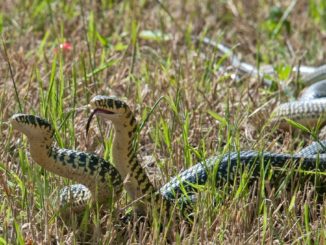
certainly nearly all grass snakes (Natrix natrix) and viviparous
lizards (Lacerta vivipara), the only snake and legged lizard
found locally. As Figure 1 also demonstrates, the animals
reported as having been bought were predominantly tortoises (37%
of the total bought animals reported upon), terrapins (29%),
snakes (13%) and lizards (11%). Overall, six in every ten of the
reptiles and amphibians reported upon had been caught rather
than bought. And of these caught animals, in approximately equal
numbers, slow-worms and frogs accounted for about half (25% and
26%, respectively), newts and toads one-third (16% and 13%) and
"other lizards" and "other snakes" virtually all the remainder.
[Figure 1]
Comparing the findings for bought taxa with data obtained from a
1992 national survey of U.K. herpetofauna retail outlets (Smart
& Bride, 1993), only tortoises and terrapins seem to be kept in
disproportionately high numbers by students compared to their
retail availability. Otherwise, the relative mix of taxa kept
largely reflects the numbers of individual animals found in
retail outlets (see Figure 2). Both tortoises and terrapins can
live for long periods, and the former are probably individuals
obtained prior to the 1983 C2 listing of Testudo species under
European Commission Directive EC3626/82, which virtually halted
imports. They are nowadays hardly available in the shops. The
high terrapin numbers can be further explained by the recent
"Teenage Mutant Ninja Turtle" fad, which is thought to have led
to a temporary increase in terrapin-buying. Besides tortoises,
terrapins, and snakes, few students reported the possession of
other bought taxa (21% of total purchased taxa reported upon),
particularly of amphibians (only 10% of total purchased taxa
reported upon).
[Figure 2 a &b]
With regard to the welfare aspects of the survey, the data do
not allow for the identification of actual lifespans or an exact
relationship between an individual animal's origin and its time
and cause of death. However, some general observations can be
made. For instance, the largest proportion of animals reported
to have died were among those taxa which had been predominantly,
or entirely, caught by the students, namely frogs, toads, slow-
worms and newts/salamanders, while the smallest proportion was
among the entirely or almost-entirely bought species: the
tortoises, terrapins, pythons and boas. One problem about
interpreting these data is that those taxa with the lowest
reported mortality were also those which included the species
with the longest expected natural lifespans, making it difficult
to draw conclusions about the welfare significance of relative
mortalities between taxa. However captive animals are generally
not exposed to predators or harsh climatic conditions.
Consequently, rates of annual mortality of wild populations,
which, for example, are estimated to be about 50% for frogs and
newts (Griffiths, 1996, personal communication (5)), should not
be expected to occur in captivity. Indeed, some captive
individuals have been known to live for remarkably long periods.
Slow-worms have been recorded as surviving for as many as 54
years (Arnold & Burton, 1978) and common toads (Bufo bufo) have
reached the remarkable age of 40 (Smith, 1973). The apparently
high captive mortality for both these species indicated by the
data recorded here (assuming the caught toads to be Bufo bufo,
which is the only common indigenous species) needs to be
examined more closely. Certainly, the data suggest that most
taxa are, for one reason or another, not kept for very long. The
exceptions are the tortoises and pythons/boas, two-thirds of
both of which were reported to still have been in the student's
possession after three years, and the terrapins, 37% of which
remained after the same period. But even these proportions seem
small. In fact, if the figures for these groups are removed from
the data, then more than 92% of the individuals described across
the remaining taxa are found to have died or been released, sold
or given away by the end of 36 months. The period that these
types of animals are being kept is a parameter which should be
investigated. If such short periods are representative of the
wider picture, then questions need to be asked as to why and how
children's possession of herpetofauna ceases.
In this context, the similarity of the line graphs relating the
period kept in captivity for the predominantly bought taxa and
for the predominantly caught taxa is worth noting (Figures 3a
and 3b). These slopes may reflect natural mortality rates,
although the longevity of slow-worms and toads would seem to
contradict this. It is more plausible that they describe a
pattern of keeping companion animals among students whereby the
levels of interest and/or commitment of many quickly wane. This
period of a young person's life is a time of great change and
many may simply become more interested in other things. Only a
few individuals continued to maintain their companion animals
for more than three years, and it is indicative that this is
particularly true for those animals which have been bought. Not
only does the fact of their purchase point to a greater level of
commitment on the part of their owners, but these species cannot
easily be released back into their natural habitat.
[Figure 3a & b]
When considered together, data on cause of death and period kept
in captivity (Table 2), point to some areas of welfare concern.
There were high numbers of escape-related deaths reported for
several taxa. Overall, some 21% of all the animals reported upon
were said to have met this fate, including nearly half of the
frogs and 28% of the newts and slow-worms. It seems, therefore,
that in many instances animals are not being furnished with
suitably secure vivaria. In fact, the differences between the
slopes of the line graphs recording the number of students who
had each taxon for certain periods (Figures 3a and 3b) may be
partially explained by the high escape-linked mortalities in
certain taxa. This conclusion is further supported by the fact
that the proportion of escape-related deaths tends to be lower
for the predominantly bought taxa, which might be expected to
have been provided with more secure accommodation.
The data for deaths linked to "other factors" include too many
possible causes to allow interpretation, but those judged as
"food-related" deaths seem to follow a pattern. The proportion
of food-related deaths was lowest for those taxa with the
highest proportions of bought animals, namely snakes, terrapins
and tortoises. Only five individual animals meeting such a death
were reported by the 233 students who had kept these taxa (2%).
Getting purchased animals to feed does not therefore seem to
have been a major problem associated with their care in
captivity. However, this is not to suggest that adequate dietary
provisions were provided, for it is widely recognized by
established herpetofauna-keepers that supplying the correct food
is probably the single most important problem they face. Just
because an animal feeds does not mean it is being properly
nourished. It might still perish as a result of malnutrition.
In considering the students' views about their own
care-knowledge for each taxon, it is difficult to make more than
a few general observations. There does seem to be a
correspondence between some of those taxa for which a high
proportion of students felt they knew enough about captive care
and those taxa with low reported levels of mortality (tortoise,
terrapin, python/boa). But this correspondence may have been
precipitated by the fact that the care-knowledge question
followed the one concerning mortality. Yet the substantial
percentages of respondents who did not reply or who felt that
they did not know enough about captive care of the largely
indigenous types are worthy of note (newts 81%, frogs 60%, toads
47%, slow-worms 46%), while the same proportion for some bought
taxa is also not insubstantial (tortoise 32%, terrapin 28%).
Furthermore, it might be argued that these data underrepresent
the true picture because students are unwilling to admit to a
lack of knowledge.
Discussion and Recommendations
Despite the limited nature of the data, they suggest some
interesting patterns and point to areas which would benefit from
further action and research. The possible class and gender
variations in the keeping of herpetofauna as companion animals
seem to deserve closer examination, as might the means by which
children's attitudes towards herpetofauna are formed and
develop. These attitudes certainly need to be examined from the
point of view of herpetological conservation. Along with many of
our native flora and fauna, British reptile and amphibian
populations have been declining over the past century (Prestt,
Cooke, & Corbett, 1974; Arnold, 1995). This decline is said to
be due to a lack of public understanding of the species' needs
and inappropriate site management, as well as the more obvious
process of habitat loss (Webb & Haskins, 1980; Swan & Oldam,
1993a, 1993b). The data relating to caught taxa from this
survey, which were nearly all indigenous U.K. species, give
particular cause for concern, for they seem to exemplify this
lack of understanding. Not only do substantial (although not
necessarily ecologically significant) numbers in certain taxa
appear to be collected as companion animals (newts, frogs,
toads, slow-worms, viviparous lizards, and grass snakes), but
large proportions of some of them (notably frogs, toads and
slow-worms -- and possibly viviparous lizards, and grass snakes)
seem to die quickly in captivity. Many of these deaths were
related to inadequate care-provision, and in some cases,
students' confidence in their own level of care-knowledge seemed
low. Since students reported on just one individual of each
taxon stipulated in the survey, the actual numbers of each
species gathered by these students having met similar fates may
have been much higher.
Whether or not wild populations are being adversely affected by
collection, the students' limited knowledge and understanding of
caught species as expressed through their poor care-provision
does not encourage the view that they are capable of
distinguishing appropriate conservation measures. This sort of
understanding is considered vital to the success of conservation
strategies (Wynne, Avery, Campbell, Gubbay, Hawkswell, Juniper
et al., 1995). It is not known whether those who have not kept
herpetofauna as companion animals would fare any better, but it
is reasonable to assume that those with experience of these
animal types are more likely to be sympathetic to their cause.
The general outlook for British reptile and amphibian
conservation suggested by these survey data does not engender
much optimism.
The welfare issues this study raises might best be addressed
through schools, either by teachers themselves or by means of
campaigns organized by appropriate animal welfare organizations.
In addition, they could be explored in relation to children's
understandings of and attitudes towards animals. There is
evidence, for instance, that many people do not recognize
reptiles and amphibians as animals. In a study of 400 five- to
eleven-year-olds, Martin and Nicholls (1993) found this figure
to range between 10-40% for both frogs and snakes. Similarly,
Tinkler (1993) recorded 60% of 150 adult zoo visitors as failing
to classify a lizard as an animal. This may be due to a
confusion of "mammal" with "animal." Bride (1996) recently found
that of 228 respondents to a questionnaire about wildlife, at
least 25% appeared to confuse the two. This view, that "animal"
equals "mammal," is interesting because it gives a new
perspective to what many people's interpretations of such
concepts as "animal protection," "animal welfare," and "animal
rights" might encompass. There are clear ramifications for
herpetofauna welfare and a need for further research in this
area.
The findings also suggest a need for more detailed data on
reptiles and amphibians obtained from retail outlets. Although
the proportion of mainly bought herpetofauna reported dead was
generally somewhat lower than that of the predominantly caught
taxa, the data still provide some cause for concern. For none of
the mainly bought taxa is the percentage reported dead less than
20% (terrapin 31%, python/boa 22%, tortoise 21%). But if
healthy, regularly feeding individuals of these taxa are
purchased and kept under the correct conditions, most species
are usually hardy and long-lived. These bought taxa data do not
name particular species and cannot be controlled for natural
mortality rates. However, a national survey of retail outlets by
Smart and Bride (1993) has demonstrated that it is easy to
purchase individuals of almost any species present in U.K.
retail outlets (even delicate and/or very specialized species)
without being asked or advised by the retailer about their
subsequent care. Their survey of an estimated 16% of the U.K.
outlets found a large number and variety of species and a
possible welfare issue to be addressed in approximately half of
the more than 500 vivaria inspected (70% of which were "lack of
refuge" and 14% "inappropriate set up"). The combination of
potentially stressful conditions for the animals at the point of
purchase, inadequate instructions given to the buyer, and a
non-specialist trade which involves a wide variety of taxa and
which appears to be largely supply-led, is unlikely to encourage
successful herpetofauna keeping among children. Although the
evidence is circumstantial, it appears that there are
significant welfare issues associated with many of the traded
reptiles and amphibians kept as companion animals.
Conclusion
Reptiles and amphibians have been traditionally feared, and at
least since Biblical times have suffered from "bad press."
However, they arguably have great educational potential. In the
field of biology they provide ideal vehicles for the study of
many subject areas, including animal ecology, physiology,
morphology, growth, reproduction, and bio-indicators. Given that
populations of many indigenous species continue to decline (Prestt,
Cooke & Corbett, 1974, Arnold, 1995) and their study and
appreciation is recognized as an important and necessary
component of their conservation (Wynne et al., 1995), this
potential is also complemented by a need. Moreover, some species
make excellent companion animals, are widely available as
captive-bred specimens (which are generally disease free), and
can be used to explore numerous issues in other subject areas,
such as prejudice, perceptions of wildlife, pet-keeping and
animal rights.
If the educational value of herpetofauna seems obvious, the
opportunities to exploit it are many. Activities which would
benefit both indigenous and traded species can be easily
integrated into the national curriculum at many key stages. Yet
the evidence from this survey points to undue suffering among
these groups of animals. The animal welfare and rights debates
do little to help the situation. They seldom refer to reptiles
and amphibians, and many of those involved in these debates are
themselves highly prejudiced in favor of feathers and fur, and
are reluctant to move the discussion away from the safe arena of
the attractive "fluffy and cuddly" creatures. The images of the
animals they support are not very contentious and are often
charged with positive emotions. One only need peruse the
contents of the published issues of this very journal to realize
that for many, in effect, "animal" = "mammal."
Although the picture revealed by this survey may be
understandable in terms of how people value different animal
types, it suggests a need for more detailed research.
Perceptions of herpetofauna and patterns of herpetofauna
pet-keeping should be explored further, while investigation of
people's understanding of what is meant by "animal" and of
patterns of pet-keeping in general would also prove valuable.
Remarkably, the RSPCA themselves have yet to commission any
study of patterns of pet-keeping among either young people or
adults. But unless the questions raised in this paper are
addressed, the apparent plight of herpetofauna kept by many
young people is likely to persist, and other companion animal
groups may be suffering in a similar way. Educational
opportunities beckon, while practical and theoretical challenges
invite and provoke. Reptiles and amphibians need all the friends
they can get. Who will take up the challenge?
References
Arnold, E. & Burton, J. (1978). A field guide to reptiles and
amphibians of Europe. London: Collins.
Arnold, H. R. (1995). Atlas of amphibians and reptiles in
Britain. London: HMSO.
Bell, D. (1991). Reptile round-up. Infant Projects No. 76. :
Scholastic Publications, Ltd.
Board of Education. (1943). Report of the Committee of the
Secondary School Examinations Council onCurricula and
Examinations in Secondary Schools. London: HMSO.
Brooks, R. (1991). Contemporary debates in education: An
historical perspective. London: Longman.
Brown, L. (1988). Cruelty to animals. London: MacMillan.
Hair, J. D. & Pomerantz, G. A. (1987). The Educational Value of
Wildlife. In D. Decker & G. Goff (Eds.), Valuing wildlife: The
economic and social value of wildlife (pp. 197-201). Boulder,
CO: Westview.
Hoff, M. P. & Maple, T. L. (1982). Sex and age differences in
the avoidance of reptile exhibits by zoo visitors. Zoo Biology,
1, 263-9.
Kellert, S. R. & Wilson, E. O. (Eds.) (1993). The biophilia
hypothesis. Washington: Island Press.
Martin, D. & Nicholls, M. (1993). The importance of children's
provenance in the understanding of "animal" - a comparison of
town and village primary school children in Kent. Christ Church
College, Canterbury: Ecology Research Group.
McGregor, H. M. (1994). An evaluation of the educational value
of a zoo reptile exhibit. Unpublished M.S. dissertation,
University of Kent at Canterbury, DICE.
Murphy, J. B. & Mitchell, L. A. (1989). `The other side' an
experiment in reptile appreciation at the Dallas Zoo.
International Zoo Yearbook, 28, 205-7.
Paul, E. S. & Serpell, J. A. (1993). Childhood pet keeping and
humane attitudes in young adulthood.Animal Welfare, 2, 321-337.
Prestt, I., Cooke, A. S. & Corbett, K. F. (1974). British
amphibians and reptiles. In D. L. Hawksworth (Ed.), The changing
fauna and flora of Britain (pp. 229-254). London: Academic
Press. RSPCA. (1995).Animals and Education. Horsham, Royal
Society for the Prevention of Cruelty to Animals.
Serpell, J. A. (1981). Childhood pets and their influence on
adults' attitudes. Psychological Reports, 49, 651-659.
Smart, A. & Bride, I. (1993). The welfare aspects to the U.K.
trade in reptiles and amphibians as pets: Report to the RSPCA.
Horsham: RSPCA.
Smith, M. (1973). The British amphibians and reptiles (5th ed.).
London: Collins.
Smy, D. (1995). An evaluation of children's perceptions of
British herpetofauna and the design of an information pack
promoting reptile and amphibian conservation. Unpublished M.S.
dissertation, University of Kent at Canterbury, DICE.
Surinova, M. (1971). An analysis of the popularity of animals.
International Zoo Yearbook, 11, 165-7.
Swan, M. J. & Oldham, R. S. (1993a). Herptile sites - Volume 1:
National amphibian survey final report. Peterborough: English
Nature.
Swan, M. J. & Oldham, R. S. (1993b). Herptile sites - Volume 2:
National common reptile survey final report. Peterborough:
English Nature.
Tinkler, D. (1993). Zoo visitors' perceptions of animals - and
the short-term effect of a zoo visit upon them. Unpublished M.S.
dissertation. University of Kent at Canterbury, DICE.
Wynne, G., Avery, M., Campbell, L., Gubbay, S., Hawkswell, S.,
Juniper, T., King, M., Newbery, P., Smart, J., Steel, C.,
Stones, T., Stubbs, A., Taylor, J., Tydeman, C., & Wynde, R.
(1995). Biodiversity challenge: An agenda for conservation in
the U.K. Sandy: RSPB.
Notes
1. Address all correspondence to Ian Bride, DICE, University of
Kent, Canterbury CT2 7NX, UK. The author would like to thank the
RSPCA, who funded the overall research project; colleagues at
DICE for comments, help and suggestions; Mr. Robin Dixon, who
conducted the pilot survey; and the head teachers, teachers and
pupils of the schools who so enthusiastically participated in
the data collecting exercise.
2. Figure based on registered class numbers and does not account
for absentees.
3. The county of Kent, England broadly retains the "Tripartite"
system of secondary education for 11-18 year-olds wherein
allocation follows an examination at the age of eleven (the
"eleven plus"). The original idea (Board of Education, 1943) was
that grammar schools (G) recruit the most academically inclined,
technical high schools (T) concentrate on the applied sciences
or arts, and the students at secondary modern schools (M) deal
more with "concrete" things. In practice, the system has
resulted in an overrepresentation of middle class students in
grammar schools and working class students in secondary modern
schools (Brooks, 1991).
4. A small handful of instances were encountered in which
students had caught herpetofauna outside the UK (geckoes, snakes
and tortoises), but such instances were unlikely to have been
common enough to fundamentally contradict this deduction.
5. I am grateful to Dr. R. A. Griffiths, amphibian population
ecologist, for this information.
For Abstracts of all issues, including the most current, click
Article
Abstracts
To order Society &
Animals Journal, go to our secure online
ordering page
You
can Search the online issues of Society & Animals, as well
as the entire Society & Animals Forum (formerly PSYETA)
website,
for topics and keywords of your interest:
|